
Sexism policy
Introduction and Purpose
This policy was developed in autumn 2024 by the management at EUC Syd and applies to all students and staff. Its purpose is to provide clear guidance on the school’s position on, and handling of, sexism and sexual harassment.
EUC Syd is both an educational institution and a workplace where there must be room for everyone, and where no one—neither students nor staff—is subjected to sexism or sexual harassment. It is essential that everyone feels welcome and respected, regardless of age, ethnicity, religion, gender identity, or sexual orientation. We foster a culture in which experiences of inappropriate behaviour can and must be discussed and addressed. Handling such matters must take place within a transparent and informed framework and must never be left as an individual problem.
The purpose of this policy is to ensure diversity through safe learning environments and inclusive communities, both in education programmes and student accommodation. We share responsibility for each other’s learning and well-being, while management holds the overall responsibility for maintaining an environment free from sexism.
This policy defines what EUC Syd considers to be sexism and sexual harassment. It also clarifies how individuals and the institution must handle incidents involving offensive behaviour. A corresponding action plan has therefore been developed, outlining preventive, responsive, and follow-up measures.
The policy is based on the Danish legislation on students’ educational environment.
Definition of sexism and sexual harassment
At EUC Syd, sexism is understood as:
Prejudice or discrimination based on gender..
At EUC Syd Sexual harassment is understood as:
Unwanted verbal, non-verbal, or physical behaviour of a sexual nature that violates a person’s dignity and creates an intimidating, hostile, degrading, humiliating, or offensive environment.1
Sexism and sexual harassment can take many forms, ranging from everyday sexism (e.g. inappropriate jokes) to serious assaults.
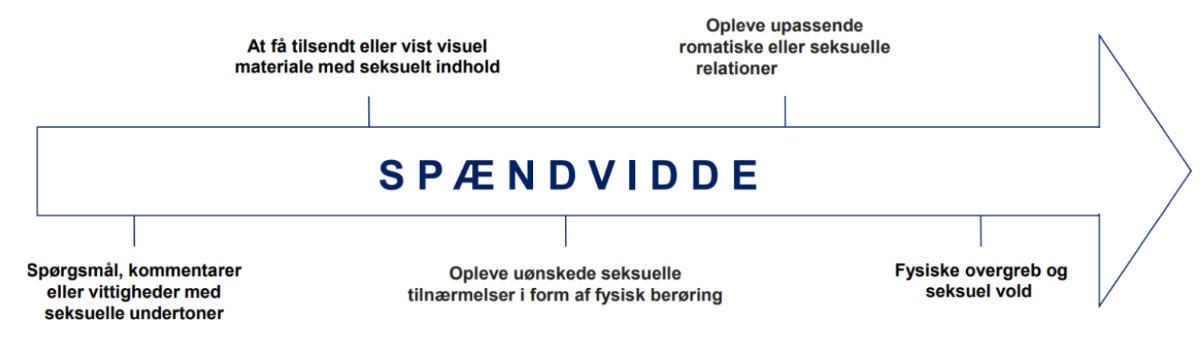
It is important to recognize that all forms of sexism and sexual harassment contribute to an unacceptable culture. If behaviour at the “milder” end of the spectrum is normalized, it reduces the barrier to more severe behaviour. This can gradually lead to the development of a sexist culture without those involved necessarily being aware of it. Therefore, all forms of such behaviour must be taken seriously and addressed.
Perceptions of sexism and harassment may vary between individuals and situations, which can make it difficult to identify. The key factor is whether a person experiences an action as offensive or violating. The intent behind the action is less important than the experience of the affected person.
Examples of sexism and sexual harassment
Sexism includes, for example:
- Excluding a woman from participation solely because of her gender
- Speaking derogatorily about boys or men who show emotions
Sexism affects people of all genders and sexual orientations and is rooted in stereotypes that limit individuals socially and culturally. It is considered a structural issue present across many areas of society.
Examples of unacceptable behaviour include:
- Unwanted sexual comments: Verbal or non-verbal expressions of a sexual nature that are inappropriate or degrading
- Offensive jokes or remarks: Sexist humour that creates discomfort
- Unwanted physical contact: Any form of physical interaction that is not consented to
- Sharing inappropriate material: Distribution of offensive images, videos, or messages, including digital content (sharing images without consent may be illegal)
- Stalking or persistent unwanted attention: Behaviour that causes fear or discomfort
Clothing and personal expression
Clothing is often a topic of discussion in relation to sexism policies.
EUC Syd does not impose specific dress codes for students or staff. Instead, expectations are based on the school’s core values of safety and respect. Respect for others includes being mindful of one’s appearance.
Individuals have the right to express themselves through clothing and appearance, provided it does not interfere with safety (e.g. in workshops) or negatively impact others’ well-being. For example, clothing displaying racist, sexist, or violent symbols (such as a swastika) is not acceptable.
If concerns arise regarding a student’s clothing, staff will address the matter through dialogue. If disagreement persists, management will make the final assessment based on the school’s values.
Action Plan: Prevention, Handling, and Follow-up
EUC Syd follows the action plan below regarding the prevention, handling, and follow-up of sexism and sexual harassment directed at students and course participants.
Contact and reporting
If you experience sexism, harassment, or unwanted sexual attention—whether involving students or staff—you have several options:
- Speak to someone you trust (e.g. a teacher, mentor, student counsellor, or manager)
- Bring a classmate for support if needed
- Contact one of the school’s designated independent contact persons
- Report to the police in cases involving illegal actions (e.g. sharing explicit material or assault), and inform your programme manager
After reporting, you will be contacted as soon as possible to agree on next steps. Conversations are generally confidential, and anonymity can be maintained unless the severity of the case requires formal action.
Contacts at EUC Syd
|
Department |
Contacts |
|
Aabenraa |
Trine Skovmand Søndergaard, mail tss@eucsyd.dk, tlf. 7412 4230, mobil 5131 5549 |
|
Haderslev |
Thomas Petersen, mail tpe@eucsyd.dk, tlf. 7412 44 72, mobil 5131 4710 |
|
College hostel in Haderslev |
Jane Bøgebjerg Müller, mail janm@eucsyd.dk |
|
Lundsbjerg |
Gitte Bork, mail gbo@eucsyd.dk, tlf. 7412 4473, mobil 5131 4717 |
|
Sønderborg |
Mikkel Hedegaard Simonsen, mail mhsi@eucsyd.dk, tlf. 7412 4404, mobil 5131 5579 |
|
College hostel in Sønderborg |
Jane Bøgebjerg Müller, mail janm@eucsyd.dk |
|
Tønder |
Jan Wilhelmsen, mail jwil@eucsyd.dk, tlf. 7412 4503, mobil 5131 4774 |
|
College hostel in Tønder |
Jane Bøgebjerg Müller, mail janm@eucsyd.dk |
Harassment at the workplace training site
If, as a student, you are experiencing difficulties or unwanted behaviour at your workplace training site, you are always welcome to contact the school representatives mentioned above. They can provide guidance on who may be able to help handle the situation, such as a trade union.
Prevention
Responsibility
All members of EUC Syd—students and staff—share responsibility for preventing offensive behaviour and promoting an inclusive culture.
Teachers play a key role in introducing students to the school’s values and acting as role models. They are also expected to address inappropriate behaviour when observed.
Management holds the formal responsibility for ensuring a safe and inclusive environment and must take action to prevent recurrence in cases of harassment.
Key Actions
- All students and staff must be familiar with the policy and action plan
- Students are introduced to expectations and their right to set boundaries
- Teaching integrates values of diversity, inclusion, and respectful behaviour
- Inappropriate behaviour is addressed promptly and proportionately
Students and student bodies are expected to contribute by ensuring:
- Inclusive social and class activities
- Speaking up and involving staff when necessary
- Maintaining respectful communication, including online
- Not sharing images of others without consent
Handling cases
When a case arises, staff should:
- Document all conversations
- Investigate the situation within 10 working days
- Speak with all involved parties individually
- Clarify experiences, intentions, and needs
- Involve witnesses if relevant
- Assess severity, intent, and conflict level
- Consider parental involvement for students under 18
Action plan measures
If a case of sexism or harassment is confirmed, an individualised action plan must be developed. This may include:
- Meetings with involved parties and support persons
- Dialogue with the class or relevant groups
- Mediation between parties
- Counselling or psychological support
- Initiatives to improve class culture
Sanctions
Confirmed cases may lead to sanctions in accordance with the study and conduct regulations.
Follow-up
The school continuously monitors student well-being data, including experiences of unwanted sexual attention.
Each case is evaluated to determine whether preventive measures should be strengthened.
A follow-up meeting with the affected person will take place no later than three months after the incident.
Complaints Procedure
If a student believes the school has not responded appropriately, they may submit a written complaint to management. If the student is under 18, a parent or guardian may do so.
The school will assess the complaint and respond in writing, stating whether it is upheld in full, in part, or rejected.